Podcast: Play in new window | Download | Embed
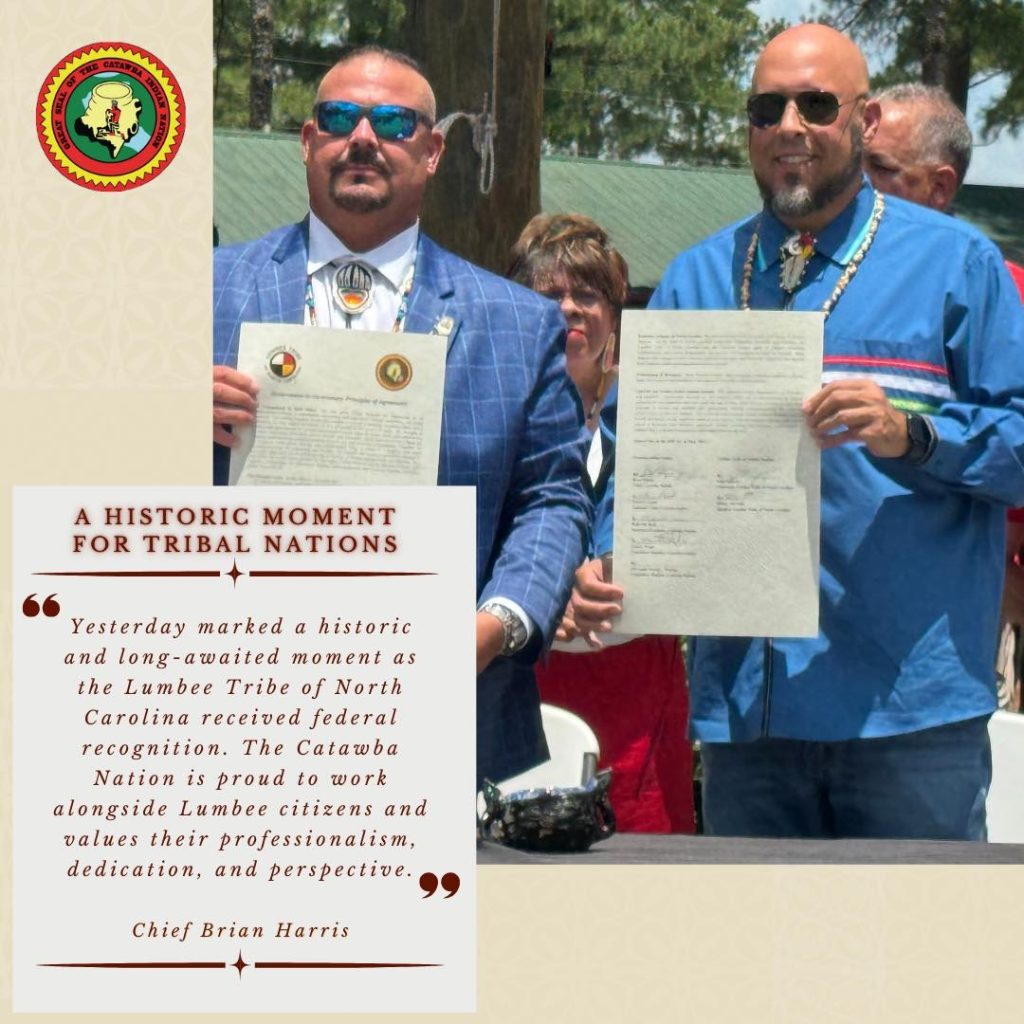
It’s official — with the swipe of President Donald Trump’s pen, North Carolina’s Lumbee Tribe is now the 575th federally recognized tribe.
Correspondent Matt Laslo has the story from Washington.
Dozens of members of the Lumbee Tribe traveled from North Carolina to Washington to be a part of history this week.
Tears were heard in the gallery after the U.S. Senate approved the measure granting the Lumbee federal recognition Wednesday.
And after President Trump signed it into law Thursday, Lumbee Chairman John Lowery could barely contain his joy.
“Weeping may endure for a night, but joy cometh in the morning, and our joy is here. It’s here. We finally achieved what our ancestors fought so long and so hard to achieve.”
There are roughly 60,000 members of the Lumbee, making it the largest Native American tribe east of the Mississippi River.
North Carolina officials recognized the tribe after the Civil War in 1885, but not federal officials.
U.S. Sen. Thom Tillis (R-NC) has helped lead the fight in the Senate in recent years.
“Yeah, we’re a little bit excited after 137 years, on their part, about 40 years on Senate members part, it’s good to see it get done.”
Tillis is retiring at the end of his term next year, but he says the decade-long battle for federal recognition for the Lumbee shows Washington isn’t totally broken — even if the tribe and North Carolina lawmakers fought an uphill battle for years now.
“A lot of educating and just, you know, prioritize the way. This is the way this works, right? You come in, you use leverage, you have discussions, you build a case. I think that’s what happened. I really appreciate the delegation. This was a well-coordinated effort.”
Back in 1956, Congress partially recognized the Lumbee, but that left the tribe locked out of federal health services. And it meant the tribe couldn’t operate casinos or marijuana dispensaries like other tribes. Chairman Lowery says it’s a new day for the Lumbee.
“The 1956 act, which left us in legal limbo, is now erased. It is no more and we are now fully, fairly recognized.”
The Eastern Band of Cherokee Indians fought the federal recognition of the Lumbee, which passed as a part of an annual $900 billion defense authorization bill.
The Prairie Band Potawatomi Nation in Kansas issued a statement this week to its tribal members about a U.S. Immigration and Customs Enforcement (ICE) contract after the deal was met with public scrutiny.
In a video statement, Chairman Joseph Rupnick said the Nation and its subsidiaries have fully divested from the ICE contract.
“As a result, Prairie Band, LLC is no longer a direct or indirect owner or participant in, or otherwise affiliated with, any ICE-related projects, contracts, or operations. In our next General Council meeting in January, Tribal Council plans to further address the steps we will take to ensure that our Nation’s economic interests do not come into conflict with our values in the future.”
Tribal citizens from across the U.S. have raised concerns about ICE and the Trump administration’s immigration policies.
Native people have also reported being confronted by ICE, including actress Elaine Miles, who has been sharing her story with media outlets about her run-in with ICE agents in November.

(Courtesy Elaine Miles)
U.S. Sen. Brian Schatz (D-HI), Vice Chairman of the Senate Committee on Indian Affairs, U.S Sen. Patty Murray (D-Wash.), Vice Chair of the Senate Appropriations Committee, and 10 of their Senate colleagues recently sent a letter to Homeland Security Secretary Kristi Noem about reports of ICE encounters with tribal citizens.
They are urging her to develop policy and trainings to recognize tribal IDs and requested a response by January 11.
Get National Native News delivered to your inbox daily. Sign up for our daily newsletter today.
Download our NV1 Android or iOs App for breaking news alerts.
Check out the latest episode of Native America Calling