Podcast: Play in new window | Download | Embed
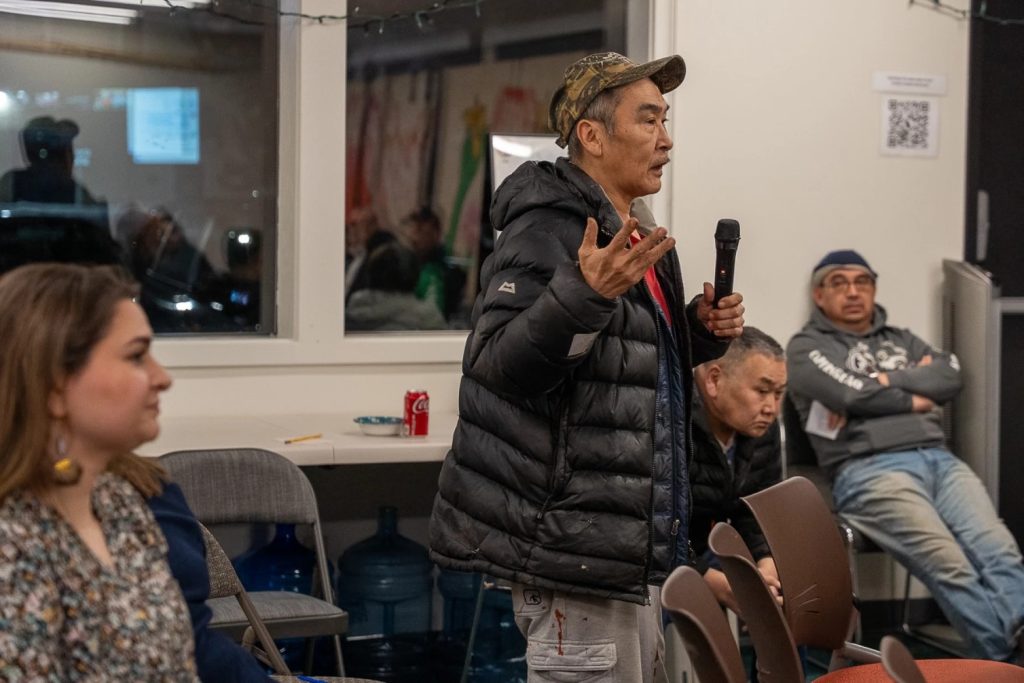
Photo: Kipnuk resident Larry Kalistook asks village and state officials questions about possible relocation during the meeting on January 31, 2026. (James Oh / Alaska Public Media)
The Alaska Native village of Kipnuk is at a crossroads.
A powerful storm last fall destroyed homes, contaminated water, and left residents with a critical decision: rebuild in the same spot or move to higher ground?
As the Alaska Desk’s Alena Naiden from our flagship station KNBA reports, the conversation is just getting started.
Kipnuk resident Rayna Paul fights back tears as she talks about how the remnants of Typhoon Halong ravaged her village — and why relocating is so important for the next generation.
“We want them to have a livable life too.”
She shared her thoughts at a recent meeting in Anchorage, where more than 50 Kipnuk residents discussed the future of their community.
Village Council President Daniel Paul says it’ll be up to the residents to decide what’s next.
“I had many calls from our tribal members, half of them wanna stay, half wanna go.”
Kipnuk is about four miles inland from the Bering Sea coast and was once home to about 700 people. Nearly everyone evacuated after the October storms.
Paul says about 100 residents are back now, working to rebuild, but there’s a lot to do.
The storm demolished about 150 homes, wiped out vital infrastructure, and left lands and water contaminated.
During the meeting, residents spoke predominantly in Yup’ik, asking what relocation could look like.
They asked about how to choose a new site and secure land ownership. And they pondered what it would take to set up critical infrastructure at a new place.
Village Council Vice President Chris Alexie says that would include a school, airport, and health clinic.
“This isn’t going to be an easy process to do, but we have to do that.”
Village officials say the relocation process can take years.
Kipnuk elder David Carl says he supports relocating.
“We’re not thinking about ourselves, who we are now, we just want to fight for our upcoming generations.”
But for Daniel Paul, Kipnuk is home and he hopes to live there again one day.
“For me, I’m gonna stick with Kipnuk, regardless of how the situation is. I was raised there, and I’ll stay there.”
Paul says the meeting was just the first step in the relocation discussion, and residents have a lot of factors to weigh.
But Kipnuk leaders also feel a sense of urgency.
Paul says the village expects only one substantial influx of federal funding. To make the best use of it, he says they need to decide soon whether they want to stay or move.

Navajo County Complex. (Courtesy Navajo County)
For decades, public health officials in Navajo County, Ariz. have been helping tribal members and elders who were not born inside a hospital with obtaining birth certificates.
As KJZZ’s Gabriel Pietrorazio reports, they have seen a spike in applicants following reports of Native people getting caught up in ICE crackdowns nationwide.
Last year, 305 residents applied for delayed birth certificates across Navajo County, two thirds of which covers tribal lands belonging to Navajos, Hopis, and White Mountain Apaches.
Violet Redbird-Nez (Kiowa and Diné) is a vital records specialist with county public health.
She treks to Kayenta quarterly to help residents get documented and for the last three months, Redbird-Nez says there is an uptick.
“They’re worried that they might get deported.”
There were 22 applicants last month alone. Once the paperwork is filled out, it typically takes six weeks.
“And it’s so endearing to know that they came by to say, ‘Hey, thank you for helping me get my birth registered. I’m legal now,’ is what they say. So that’s awesome.”

Indian Health Service is headquartered in Rockville, Md. (Photo: Antony-22 / Wikimedia)
U.S. Sens. Catherine Cortez Masto (D-NM) and Mike Rounds (R-SD) introduced this week the Stronger Engagement for Indian Health Needs Act.
The legislation elevates the role of the Indian Health Service (IHS) Director to Assistant Secretary for Indian Health within the Department of Health and Human Services.
Senators say elevating the position would give IHS greater authority to address the health care needs of Native communities.
Get National Native News delivered to your inbox daily. Sign up for our daily newsletter today.
Download our NV1 Android or iOs App for breaking news alerts.
Check out the latest episode of Native America Calling
Thursday, February 5, 2026 – Can caribou slow the drive for oil and mineral development in Alaska?