Podcast: Play in new window | Download | Embed
Microgrids can be a lifeline in remote areas prone to power outages, according to local and tribal leaders in Humboldt County in California.
Leaders spoke at an event on energy security in an era of wildfire, drought, and sea-level rise — linked to climate change.
Suzanne Potter has more.
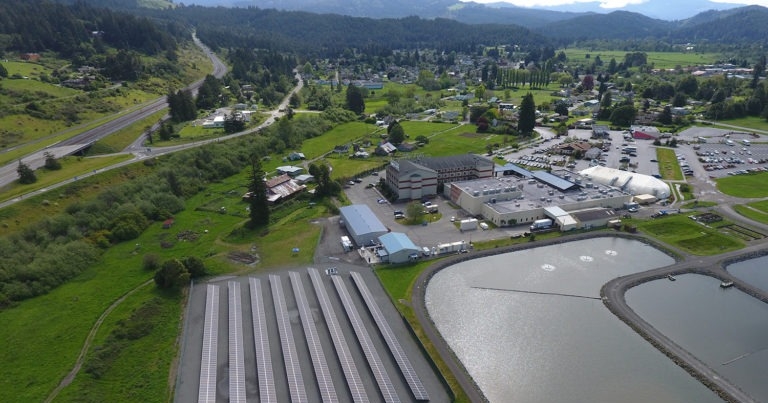
Dr. Arne Jacobson, director of the Schatz Energy Research Center at California State Polytechnic University, Humboldt says microgrids often involve solar panels plus battery storage.
“During normal operation, they’re connected to the regional grid, and they can export power and generate revenue. And during a regional grid outage, they operate in “island mode” and can provide resilience energy services.”
Microgrids have gained popularity in recent years as utilities have had to shut off power intermittently during wildfires and high wind events.
Jacobson adds that the Willow Creek and Hoopa substations and their associated circuits in the Humboldt area are frequently on the top 10 list of least reliable circuits in the state.
Beth Burks, who directs the Redwood Coastal Energy Authority, says its microgrid serves as backup power to the airport, and kept it online for 15 hours in December 2022, when an earthquake knocked out power.
“We’re all familiar with how important it is to keep the airport going. We do emergency medical transport out of there, and the Coast Guard serves 250 miles of search-and-rescue territory. And again, we can keep them going when we go into ‘islanding.'”
“Islanding” is the term for a system that can kick in and power a local area when the main utility grid goes down.
Heidi Moore-Guynup with the Blue Lake Rancheria Tribe says its microgrid saved the day during the 2022 blackout, keeping several tribal buildings running so they could provide ice, gas, medical care, and lodging.
“We want to be known as the safe place to go, the islands in times of despair. We are a very small rural community, but we are engaged in technological advances that can help rural global energy access.”

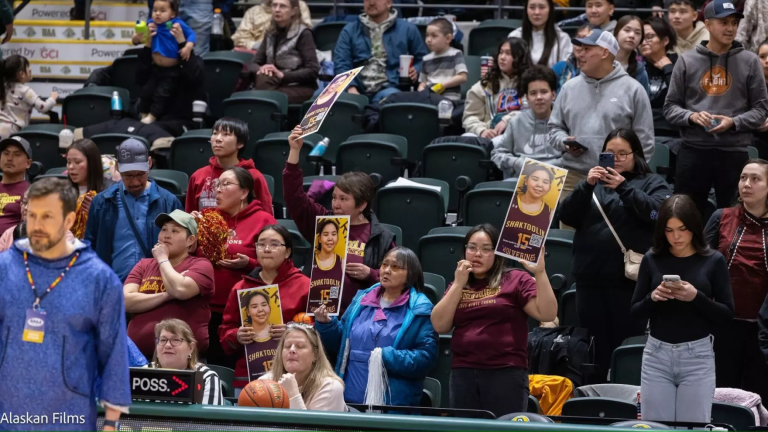
Ketchikan-based artist Savannah LeCornu was selected as this year’s poster artist for the Alaska Folk Festival in Juneau, Alaska. (Courtesy Jason Baldwin)
Ketchikan, Alaska-based artist Savannah LeCornu was recently selected as this year’s poster artist for the Alaska Folk Festival in Juneau.
The annual spring event seeks art submissions from Alaska creatives for festival merchandise, including its promotional poster.
KRBD’s Hunter Morrison sat down with LeCornu to discuss how the opportunity will help expand representation of Indigenous artists throughout Alaska.
Hunter Morrison: Can you tell me a little bit about what inspires your work as an artist?
Savannah LeCornu: I’m an Indigenous artist. I’m part of three different tribes. I’m Tsimshian, Haida and Nez Perce. So a lot of my inspiration comes from the art styles of my tribes, as well as my family, surroundings, environment, friends, that kind of thing.
HM: Can you tell me a little bit more about what mediums of art you specialize in?
SL: Yeah. So mainly I draw and I paint. I do a lot of traditional drawing, but I also do digital drawing as well. So, working with Procreate on my iPad. And then I also do painting, mainly acrylic, but I have done watercolor here and there.
HM: You were selected as this year’s poster artist for the Alaska Folk Festival. Do you have a design yet for that poster? Or, do you have ideas of what that design might look like?
SL: I don’t know how secret they are with it. I will say my inspirations were some of my favorite musicians in Alaska, as well as the northern lights.
HM: How will this opportunity expand not only your work as an artist, but expand the celebration of Indigenous people and Indigenous art?
SL: Wow, what a great question. What I’m hoping for with being the artist for this year’s folk fest is that my art gets started to be seen more widely throughout Alaska. I will say it’s not my most obvious Indigenous design. I will say all of my art inherently becomes Indigenous because I am Indigenous, but at the same time, there’s no form line in it. There’s no traditional Native art in it for this design. But I still hope that means that people look into my own art and see more of what I do, and that people just explore more of it.
Get National Native News delivered to your inbox daily. Sign up for our daily newsletter today.
Download our NV1 Android or iOs App for breaking news alerts.
Check out today’s Native America Calling episode
Thursday, March 26, 2026 — Native Bookshelf: Unsettling Territory and Sons of Gunshooter

Leave a Reply