Podcast: Play in new window | Download | Embed
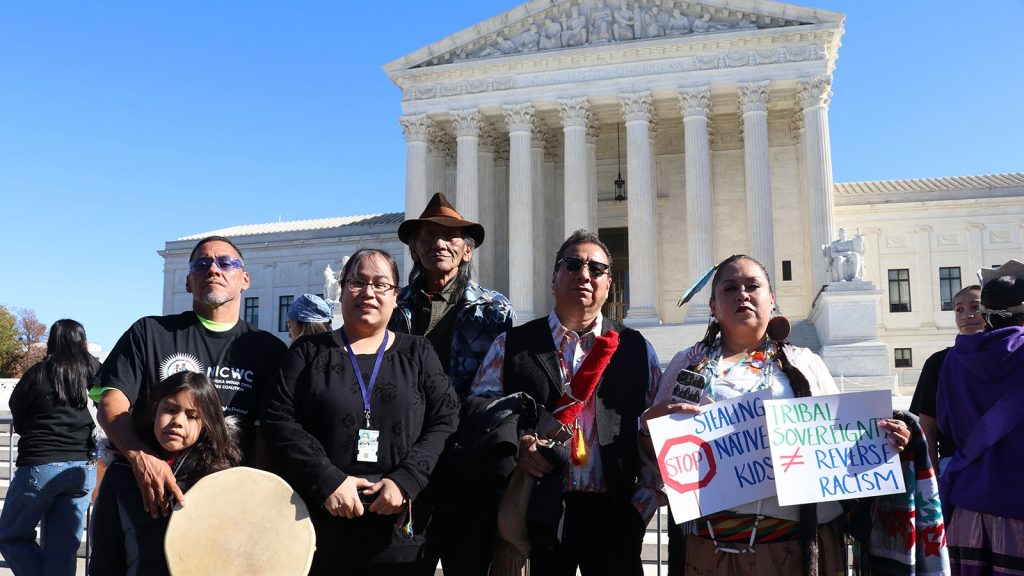
Photo courtesy National Indian Child Welfare Association
The U.S. Supreme Court upheld the Indian Child Welfare Act in 2023, according to reporting by SCOTUSblog, affirming the law’s role in keeping Native children connected to their families and tribes.
But nearly two years later, implementation challenges remain.
Legal analysis from Cornell Law School says states are still working to fully carry out ICWA’s requirements, including placement preferences and coordination with tribal governments.
And according to the National Indian Child Welfare Association, tribal leaders say the law is critical to protecting Native children and preserving cultural identity, and are calling for stronger enforcement nationwide.

D. John Sauer is sworn in by then-Attorney General Pam Bondi with President Donald Trump one year ago this week.
In the U.S. Supreme Court showdown over the 14th Amendment last week, justices sharply questioned the Trump administration’s lawyer for invoking Native American history to challenge the birthright citizenship of immigrants.
KNBA’s Rhonda McBride reports on why his argument faced resistance.
In defending President Donald Trump’s executive order against birthright citizenship, U.S. Solicitor General John Sauer compared Indian tribes to foreign governments.
He argued that the U.S. Constitution treats tribes as sovereign nations and that when the country was founded, tribal members and their children were not considered citizens, much like the children of foreign diplomats, a standard Sauer says should be applied to immigrants.
Justice Sonia Sotomayor challenged Sauer’s reasoning.
“You’re using some pretty obscure sources to get to this concept. The Indian Tribes were analogized to foreign diplomats. So what do we do with that?”
Sauer replied, “I think with the Indian Tribes, we think that’s a case that strongly supports us.”
But Bob Anderson (Chippewa), an Indian Law Professor at Harvard, says that comparison does not hold.
“The Indian law case just doesn’t fit with anything that they’re trying to do. And they were really trying to make it apply and I think they failed.”

Bob Anderson took on the subsistence rights case of Katie John when he was an attorney for the Native American Rights Fund in 1985. (Photo: Rhonda McBride)
Anderson says those doubts about Sauer’s case appeared to cut across ideological lines.
“It seemed to me that the conservative members of the court recognized that. I was surprised that they seemed to be so much in alignment with the opponents of the Trump administration.”
Justice Neil Gorsuch, widely regarded as an expert on Indian Law, pressed Sauer on Native American citizenship.
“Do you think they’re birthright citizens?”
Sauer responded, “No. I think the clear understanding that everybody agrees in the congressional debates is that the children of tribal Indians are not birthright citizens.”
Justice Gorsuch eventually got Sauer to agree that by today’s standards, tribal Indians are birthright citizens, but then Sauer walked that back.
“I’m not sure. I have to think through that.”
Based on Sauer’s arguments, Anderson says Native Americans should not worry about their citizenship status.
“No, there’s no way that this case could affect the citizenship of Indian tribes, because Congress passed the separate law in 1924, automatically making all tribal members in the United States citizens as well as their children.”
The 1924 law passed decades after the 14th Amendment – to close the loophole that had left Native Americans without automatic citizenship.
The law, however, did not affect their tribal government-to-government status under the Constitution.

AIHEC CEO Ahniwake Rose. (Courtesy Ahniwake Rose / LinkedIn)
Leaders from tribal colleges and universities are calling on Congress to increase federal funding, saying current support falls short of what is needed.
The American Indian Higher Education Consortium (AIHEC) says tribal colleges receive significantly less funding per student than other public institutions, despite serving communities with high financial need.
AIHEC President and CEO Ahniwake Rose says, “A flourishing tribal higher education sector strengthens the entire nation.”
Leaders are urging lawmakers to fully fund tribal college programs, saying the federal government has a trust responsibility to support Native education.
Get National Native News delivered to your inbox daily. Sign up for our daily newsletter today.
Download our NV1 Android or iOs App for breaking news alerts.
Check out today’s Native America Calling episode



Leave a Reply