Podcast: Play in new window | Download | Embed
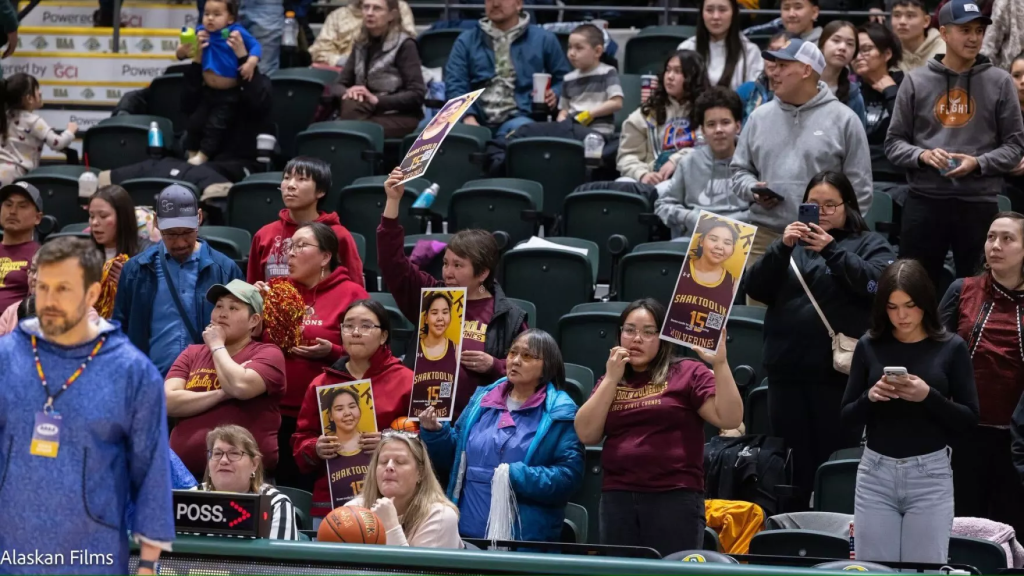
Photo: Audience holding up Kelly Hunt’s poster at March Madness game. (Waatsasdiyei Apayakuk Yates)
Kelly Hunt was just 19 when she went missing from Shaktoolik, a small community near Nome.
It is the kind of loss that does not just affect one family. It rocked an entire village — and reached hundreds of miles away — to the Alaska Airlines Center in Anchorage, where March Madness brought teams from across the state together.
As KNBA’s Jill Fratis tells us, a group of high school basketball players made sure her name is not forgotten.
The stands were full. The energy was high. And on the court, the Shaktoolik Wolverines were in the spotlight.
Then, for a moment, the game pauses. And the focus shifts far beyond basketball. All at once, dozens of people stand and raise posters that read: “Bring Kelly Home”.
Alexis Savage had no idea what would happen next.
“Everyone came with so much passion, and you could feel it in the arena. And I just wanted it to feel like, if she was right there, she could feel everybody fighting for her, and that’s really what it was. When people were chanting her name, I just felt goosebumps.”
What many don’t know is that Kelly Hunt played on this same basketball court just a year ago as a senior in high school. She played Number 15 for the Wolverines.
Savage says moments like this matter because awareness for missing people like Kelly needs to be sustained to make a difference, especially in Alaska, where cases involving Alaska Natives often don ot get the attention they deserve.
Savage is from Buckland, a close-knit Iñupiaq community not unlike Shaktoolik. She says Kelly’s disappearance hits close to home.
“I had a loved one from my hometown go missing, a few years back, and I just felt like there wasn’t very much action taken, and that was the start of my advocacy, where I just felt the need to speak up for people that just can’t speak for themselves.”
Savage has children of her own and says stories like Kelly’s are a reminder of why it’s so important to keep speaking up, to keep sharing names and faces, and to never let cases like fade from public view.
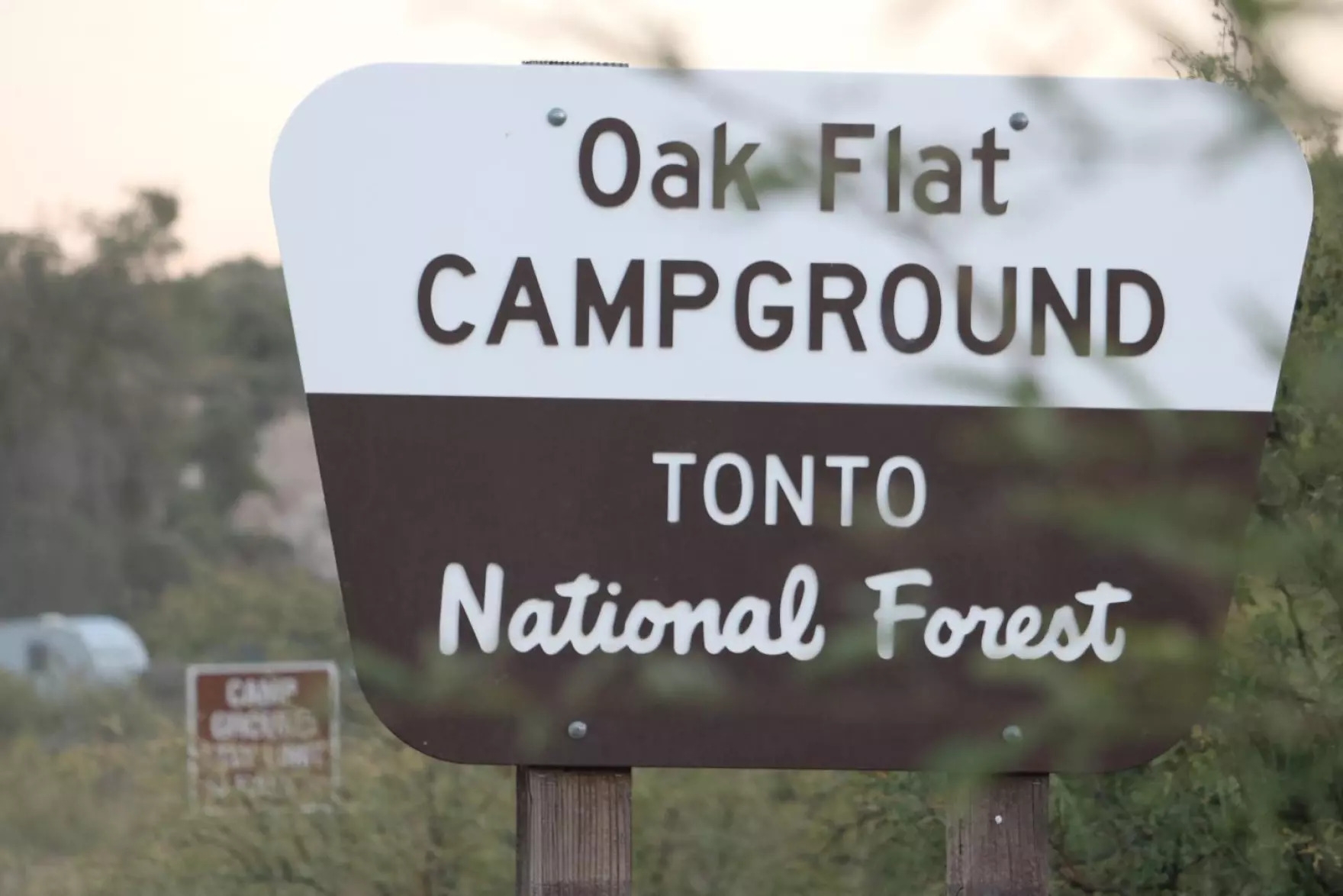
The Oak Flat campground, formerly located within the Tonto National Forest before a congressional land exchange was executed in March 2026. (Photo: Gabriel Pietrorazio)
Oak Flat is no longer part of the Tonto National Forest following a recent land exchange.
The 2,400 acres just east of Phoenix – long-considered Apache holy land – is now private property belonging to a multinational mining company.
KJZZ’s Gabriel Pietrorazio has more on what’s next.
Despite new ownership, Resolution Copper president Vicky Peacey stresses Oak Flat will remain mostly untouched.
“We wanted to make sure that the look, the feel of the area, was very similar to how the Forest Service had managed it.”
Minus a massive two-mile-wide crater expected to swallow Oak Flat within the next four or so decades. In the meantime, they hired 4Winds Contracting to maintain it.
“All their employees are from San Carlos, so they will be out there to manage the campgrounds to make sure they keep clean, orderly, and neat.”
A new website is letting larger groups apply for special use permits.
“If people want to come and use the campground, it is open. If people want to use it for cultural purposes, absolutely welcome to do so. And we’re excited to work with everybody…”
Even Apache Stronghold. The nonprofit fought the copper mine all the way to the U-S Supreme Court.
A spiritual gathering is planned there this weekend – a first since a panel of federal judges allowed the congressional land exchange to go through.
Get National Native News delivered to your inbox daily. Sign up for our daily newsletter today.
Download our NV1 Android or iOs App for breaking news alerts.
Check out today’s Native America Calling episode
Tuesday, March 24, 2026 – A movement assesses the legacy for César Chávez

Leave a Reply