Podcast: Play in new window | Download | Embed
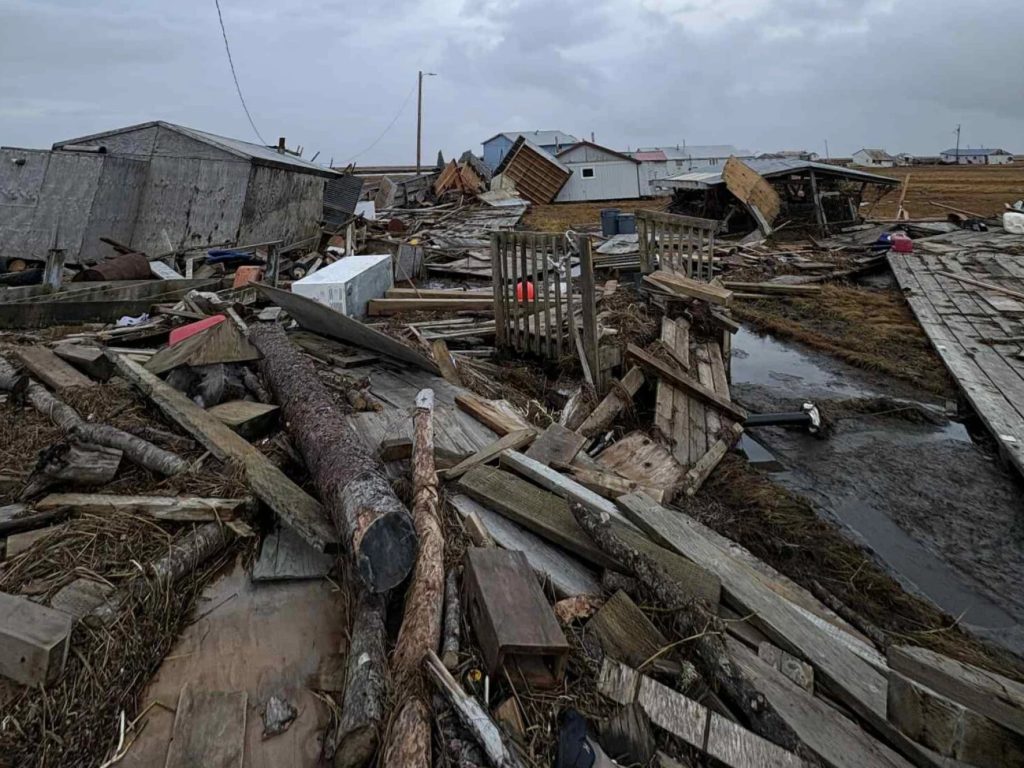
Photo: Debris sits in piles in Kwigillingok after the remnants of Typhoon Halong brought widespread devastation to the region. (Brea Paul)
The Federal Emergency Management Agency (FEMA) opened $1 billion in grants for disaster management last week.
The news comes after the agency terminated the program for that work a year ago, but a federal court found that termination unlawful, and ordered the agency to restart it.
The Alaska Desk’s Alena Naiden from our flagship station KNBA has more on what that means for some tribes in Alaska.
FEMA opened applications for a program to help communities protect themselves from fires, floods, earthquakes, and hurricanes.
The agency canceled the program last year, but a federal judge in the U.S. District of Massachusetts ordered that the agency reinstate the funding.
Dustin Evon is tribal resilience coordinator for the village of Kwigillingok in Western Alaska, one of the villages hit hardest by the ex-Typhoon Halong.
The village participated in the FEMA program, before it was canceled.
Evon says it is still unclear how useful the new version of the program will be for Alaska villages like his.
“There is good news, but we’ll see how it goes. A lot of these grants don’t really fit our rural Alaska villages.”
Last spring, FEMA canceled its program Building Resilient Infrastructure and Communities (BRIC). The agency called it wasteful, ineffective, and too concerned with political agendas.
Twenty states sued FEMA in response.
Kwigillingok residents for years have been working to protect themselves from flooding and erosion and voted to relocate several years ago.
In 2022, the village was accepted into the BRIC program to select a relocation site. Village leaders also applied for another BRIC grant to do a feasibility study for the site, but the program was canceled.
“We were all devastated. This is like a year and a half of work out on the drain.”
FEMA said BRIC has a few changes following the order to relaunch.
The agency said it will eliminate phased projects, funding for hazard mitigation planning, and technical assistance provisions – the very things that tribes like Kwigillingok applied for in the past.
Evon says he is concerned that the agency is not planning to do phased projects.
“Alaska has four seasons, and we can only do summer-to-freeze up projects. And the project we were planning was going to be multi-year and in phases.”
The application for the program is open until late July.
 A new partnership between journalism and legal experts aims to improve how stories are reported across Indian Country.
The Indigenous Journalists Association (IJA) and the Center for Indigenous Law and Justice (CILC) at UC Berkeley School of Law announced a national collaboration this week focused on strengthening coverage of Native Nations.
The effort will provide journalists with training in federal Indian law, tribal sovereignty, and best practices for reporting in Native communities.
Merri Lopez-Keifer, CILJ Executive Director, said in a joint statement announcing the partnership, “By working together, we can ensure that reporting on Indian Country is grounded in legal accuracy, cultural respect, and a deeper understanding of tribal governance.”
Leaders say many of the most important issues in Indian Country — like missing and murdered Indigenous people (MMIP), water rights, and child welfare — are shaped by complex legal systems that are often misunderstood.
Rebecca Landsberry-Baker, IJA Executive Director, also said in the joint statement, “Journalists need access to clear, accurate information about federal Indian law and tribal systems. This partnership helps meet that need while centering Indigenous perspectives and community-informed practices.”
Organizers say the collaboration will include workshops, webinars, and national training opportunities aimed at improving the accuracy and integrity of reporting on Native Nations.
Get National Native News delivered to your inbox daily. Sign up for our daily newsletter today.
Download our NV1 Android or iOs App for breaking news alerts.
Check out today’s Native America Calling episode
Wednesday, April 1, 2026 – Record-setting ‘heat dome’ is harbinger of another unnaturally hot summer

Leave a Reply