Podcast: Play in new window | Download | Embed
Photo: Marilyn Balluta drums for the Nuvendaltun Ch’naqa K’eljeshna – Children of Nondalton Dancers. (Jeff Chen / Courtesy The MMIWG2s Alaska Working Group)
The issue of missing and murdered Indigenous people (MMIP) continues to impact families and communities across Alaska.
This week, advocates, tribal leaders, law enforcement, and policymakers gathered in Anchorage for the state’s first Justice Summit to discuss solutions and next steps.
KNBA’s Rhonda McBride reports.
The gathering opened on an emotional note at the Dena’ina Center with a keynote speech from Abigail Echohawk, director of the Urban Indian Health Institute in Seattle, Wash.
Echohawk was raised in the Interior Alaska community of Copper Center and spoke about her own trauma.
“I was six years old the very first time I experienced rape. Sometimes, even now, as a person who sometimes gets triggered by the work that I do, I can close my eyes and feel the pain.”
A pain that Echohawk says almost led her to take her own life at the age of nine. At the time, she did not know her father had contacted Alaska State Troopers.
“We knew who the perpetrator was. The conversation that happened basically ended up like this: ‘She’s an Indian girl. We don’t have the resources, nor the time. Just keep him away from her.'”
In 2018, Echohawk helped to publish a landmark study that examined more than 500 cases of missing and murdered Native women. She says the findings confirmed that more than one in five cases did not exist in law enforcement data bases.
“So we actually found in this snapshot of 71 cities across the United States, that the data was not there, and it was in our minds, purposefully being held back and not being collected.”
Echohawk says Anchorage, Fairbanks, and Juneau were included in the study.
She said law enforcement cited classification methods for the missing data – and what they described as “vulnerabilities in Native culture” – explanations that Echohawk says reflects systemic, racial bias. But whatever the reason, she says the lack of data has real consequences for Native communities — because it limits resources for investigations, healing and community safety.
“This isn’t this isn’t a handout we’re asking for. This is justice we’re asking for.”
The summit also featured breakout sessions from regional groups, who will discuss the status of MMIP cases in their region.
The conference was organized by the Missing, Murdered Indigenous Women, Girls, and Two-Spirit Alaska Working Group.
It drew tribal representatives from across Alaska and as far away as New Zealand.
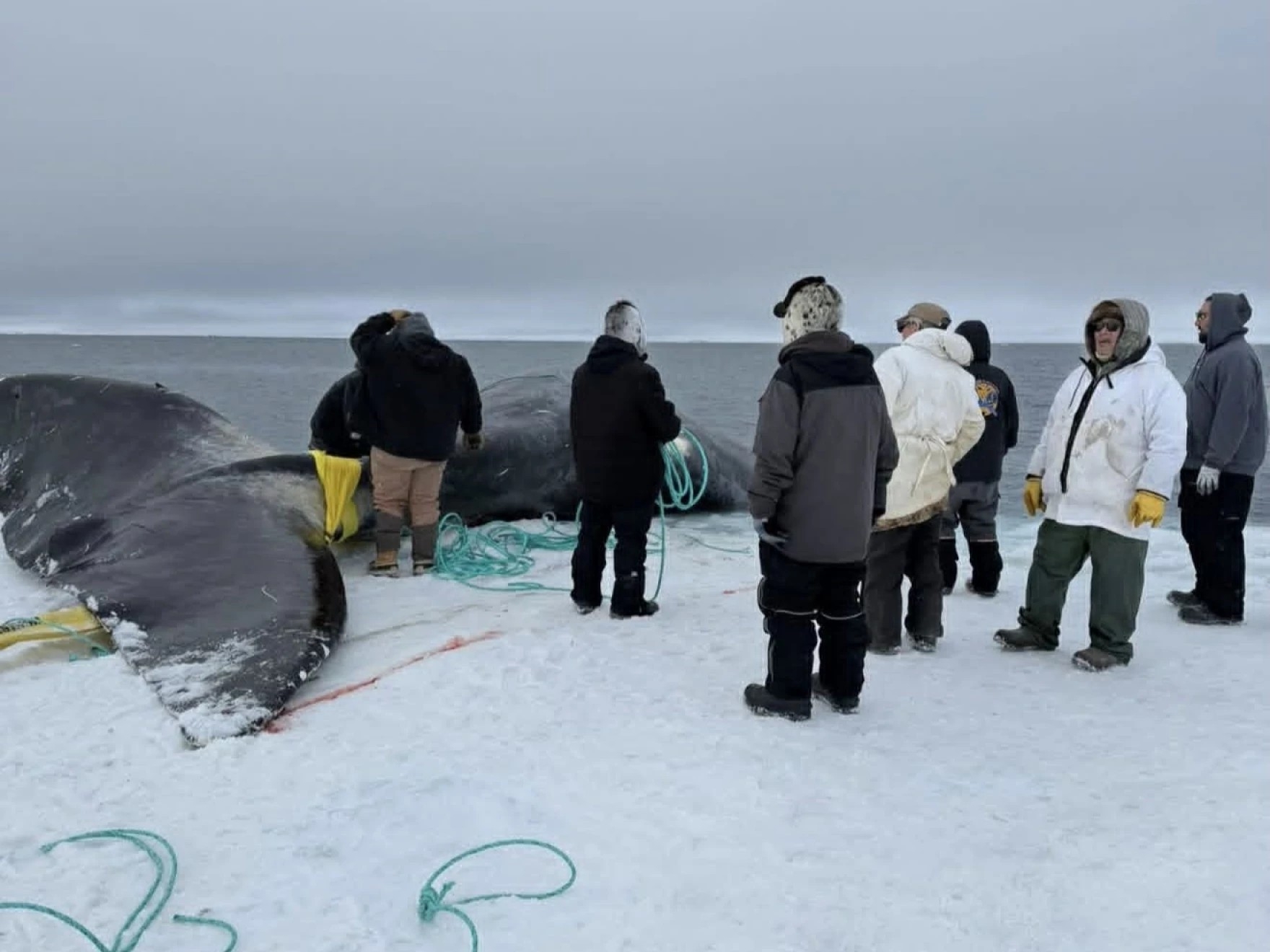
Hopson II crew landed a whale on May 23, 2026 — the first spring whale for the community this year. (Photo: Chucky Panitchaiq Hopson II)
Spring whaling is one of the most important traditions in Utqiagvik, but this year, unusual sea ice conditions delayed the harvest and the community did not land its first whale until late in the season.
The Alaska Desk’s Alena Naiden from our flagship station KNBA reports.
Chucky Panitchaiq Hopson had been whaling for about a month before he landed one this spring.
“I told my crew, at our next opportunity we’re gonna take that chance. And that very same next day, we got on to that whale, and my crew didn’t hesitate to take it, to strike it.”
By this point, Hopson says Alaska’s largest subsistence whaling community has typically landed 10 or more, but this year, Hopson says the ice edge is ragged, with very few flat spots for pulling up a whale. And there is a lot of young, thin ice, too weak to hold big whales.
In fact, when the crews were pulling up the 50-foot whale last weekend, some of the ice broke under it – Hopson thought they were going to lose a lot of the harvest.
“Once it got to the thicker ice, we were able to get it up.”
Daaqsi Moore was one of the hunters who helped the Hopson crew land the whale.
“People were getting frustrated, you know. People get hungry for muktuk. It was good to see everybody’s spirits flip when Chucky landed that whale.”
Utqiagvik, like other coastal Arctic communities in Alaska, relies on whaling as a crucial food source and to maintain Iñupiat traditions.
Andy Mahoney is a research professor at the University of Alaska Fairbanks’ Geophysical Institute.
Mahoney says that normally, young ice forms earlier in the year. Then wind storms push the new ice against the existing, shorefast ice to create ridges. By whaling season, the ice consolidates and thickens.
“The key part of it is timing.”
This winter was quite cold in Utqiagvik, but the Arctic overall is warming faster than the rest of the world.
“In a warming Arctic, these sorts of events are going to become more likely. Conditions will be more sensitive to a sort of a mistimed storm if the ice is already thin.”
Hopson says that after landing the whale, his crew spent two days processing it on the ice. Then they shared some of the harvest with the community – a little taste before the big whaling festival that usually happens later in the summer.
On Thursday, Hopson was headed out to the ice again. He says he really hopes that first whale will not be their only one of the season.
Get National Native News delivered to your inbox daily. Sign up for our daily newsletter today.
Download our NV1 Android or iOs App for breaking news alerts.
Check out today’s Native America Calling episode
Monday, June 1, 2026 — Alaska bears are the targets of a controversial management program