Podcast: Play in new window | Download | Embed
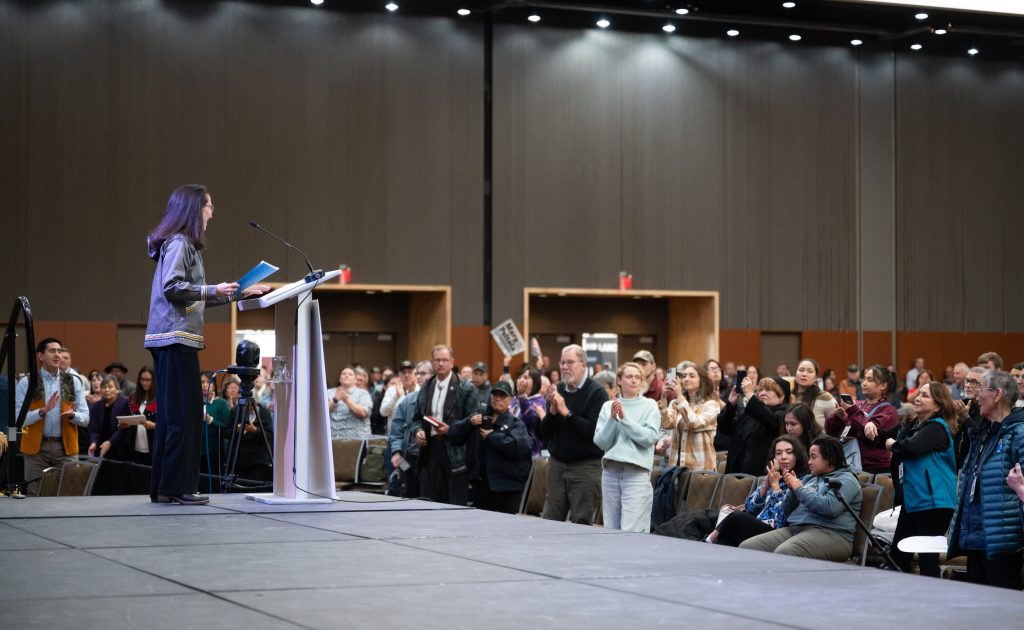
U.S. Rep. Mary Peltola receives standing ovation from delegates at the 2025 Alaska Federation of Natives Convention. She is expected to be one of the candidates to appear at this year’s convention in October. (Photo: Matt Faubion / Alaska Public Media)
The Alaska Federation of Natives (AFN) will celebrate the anniversary of its 60th convention this October.
Rhonda McBride from our flagship station KNBA has more on plans for this milestone gathering.
“Rooted in Land and Tradition, Rising in Our Voices.” That’s theme for this year’s AFN Convention.
AFN President Ben Mallott says it reflects six decades of advocacy and the power of collective voices.
“We have taken our convention, over 60 years, and have made it in, I think, the state’s largest meeting, with a broadcast of over 100,000 viewers. That’s a powerful tool for our community.”
In 1966, about 400 Native leaders from across the state gathered above an Anchorage storefront on Fourth Avenue to fight for their ancestral lands.
This first gathering laid out the groundwork for the passage of the Alaska Native Claims Settlement Act (ANCSA) in 1971 — still the largest lands settlement in U.S. History.
Today, the convention draws thousands of people, along with state and national leaders.
Mallott says this year’s keynote speaker is Dr. Rosita Worl, president of the Sealaska Heritage Institute and a longtime AFN board member. Mallott says Worl has dedicated her life to advancing Native causes.
“It’s Rosita. Dr. Worl, she’s an icon. She’s a legend. She has built Sealaska Heritage Institute into the institution it is now in Juneau, and she’s also one of our strongest advocates for subsistence.”
Mallott says this fall’s convention will also feature candidate debates for the U.S. Senate, U.S. House, and Governor’s races — and will be part of an extensive Get-Out-The-Native-Vote campaign.
AFN will be held for three days at the Dena’ina Center in Anchorage, Alaska starting on October 22.
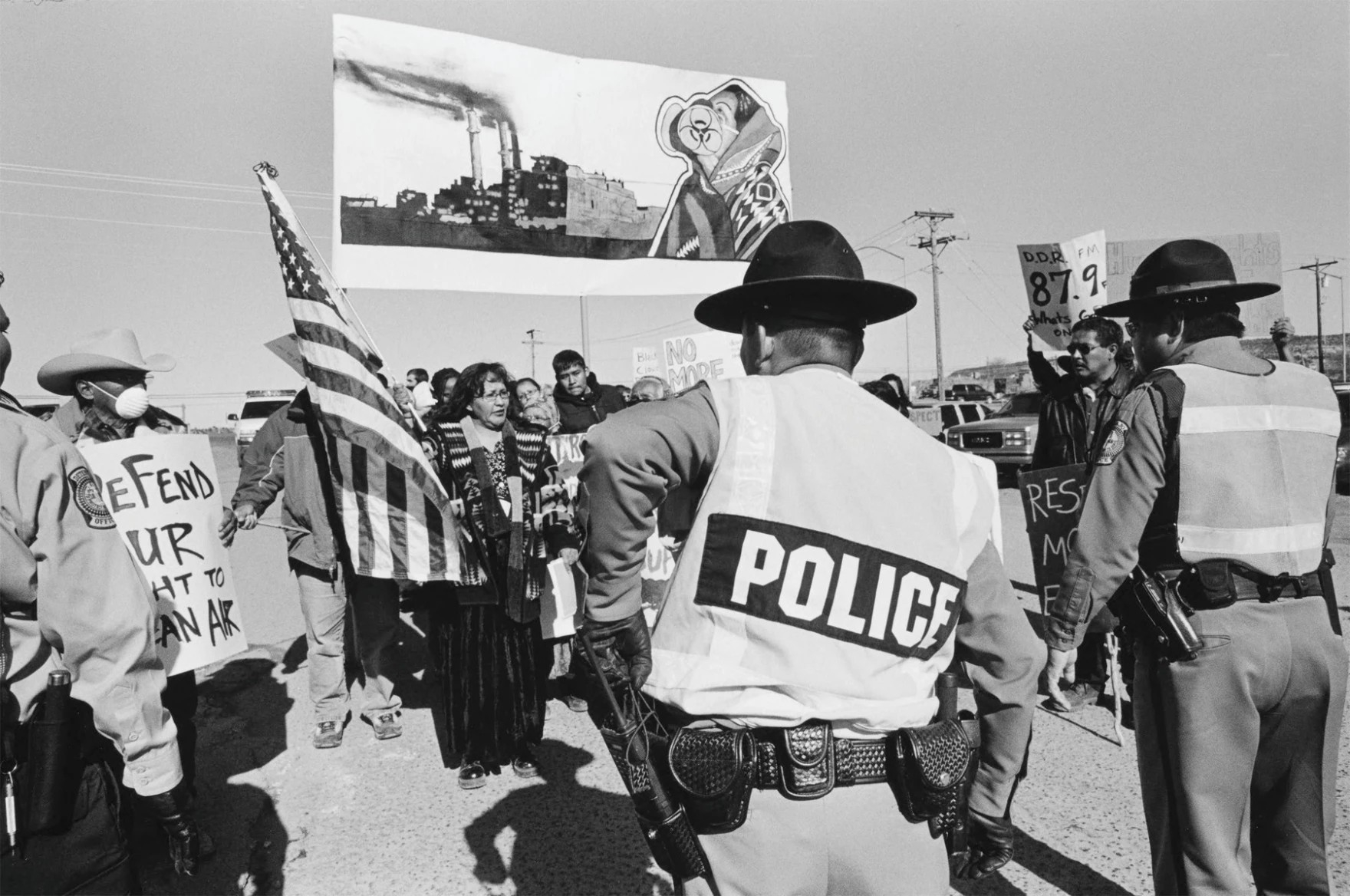
On January 9, 2007, members of the Navajo Nation, faced with the devastating health and environmental effects of yet another coal-burning power plant, staged a peaceful demonstration in Window Rock, Ariz., on the day that returning Navajo Nation President Joe Shirley was sworn in. Peaceful demonstrators were forcibly stopped and blocked from attending the inauguration by the Navajo Nation Police. (Photo: Carlan Tapp / Palace of the Governors Photo Archives)
An exhibit at the New Mexico History Museum in Santa Fe, N.M. highlights the successful campaign by three Diné women to stop a coal-fired power plant on the Navajo Nation.
KUNM’s Jeanette DeDios (Jicarilla Apache and Diné) talked with one – Sarah Jane White – and photographer Carlan Tapp (Wacomico/Anglo).
“A Question of Power” features 40 black and white photographs by Tapp as well as video and audio interviews with residents on the Navajo Nation between 2004 and 2011.
They include tense confrontations between tribal members and authorities over plans by the Dine’ Power Authority to build the Desert Rock plant on the Navajo Nation near Farmington, N.M.
Robin Jackson is the executive director for Diné Citizens Against Ruining the Environment (C.A.R.E.), a nonprofit that works with Navajo communities on energy and environmental issues.
“President (Richard) Nixon had declared that certain parts of the U.S. would be sacrificed for energy production in order to meet energy needs for some of the bigger cities like Los Angeles or Phoenix and others.”
In the wake of the 1973 oil crisis, Nixon announced Project Independence that included expanding nuclear development, including lands inhabited by Native Americans.
A 2010 research article identified 37 Navajo communities with high rates of certain diseases and conditions associated with coal power plants. The growing number of children with asthma was one of the reasons Sarah Jane White became involved.
“So I went around the schools too, and I found out just how many children were having respiratory issues.”
She says the majority of the Navajo people opposed Desert Rock and wrote letters to then Navajo President Joe Shirley Jr. She says plant owners tried to get her to stop protesting against Desert Rock by offering her sons jobs.
White was joined in her fight by Lucy Willie and Molly Hogue.
Tapp was drawn to their compelling story.
“The thing I thought, I have got to keep really good notes on this for some reason. I don’t know why.”
Tapp traveled with White, Willie, and Hogue to different communities on the reservation, and he says that it was eye opening.
“I could not believe it. People without electricity, people without running water.”
Tapp’s photographs and interviews also helped in the fight against Desert Rock. Ultimately, the Desert Rock Energy project was officially canceled in 2011 due to the continued opposition.
With the closure of another plant, the San Juan Generating Station in 2022, Jackson says you can see the difference in the air.
There is still one active power plant on the Navajo Nation scheduled for decommissioning in 2031.
Get National Native News delivered to your inbox daily. Sign up for our daily newsletter today.
Download our NV1 Android or iOs App for breaking news alerts.
Check out today’s Native America Calling episode