Podcast: Play in new window | Download | Embed
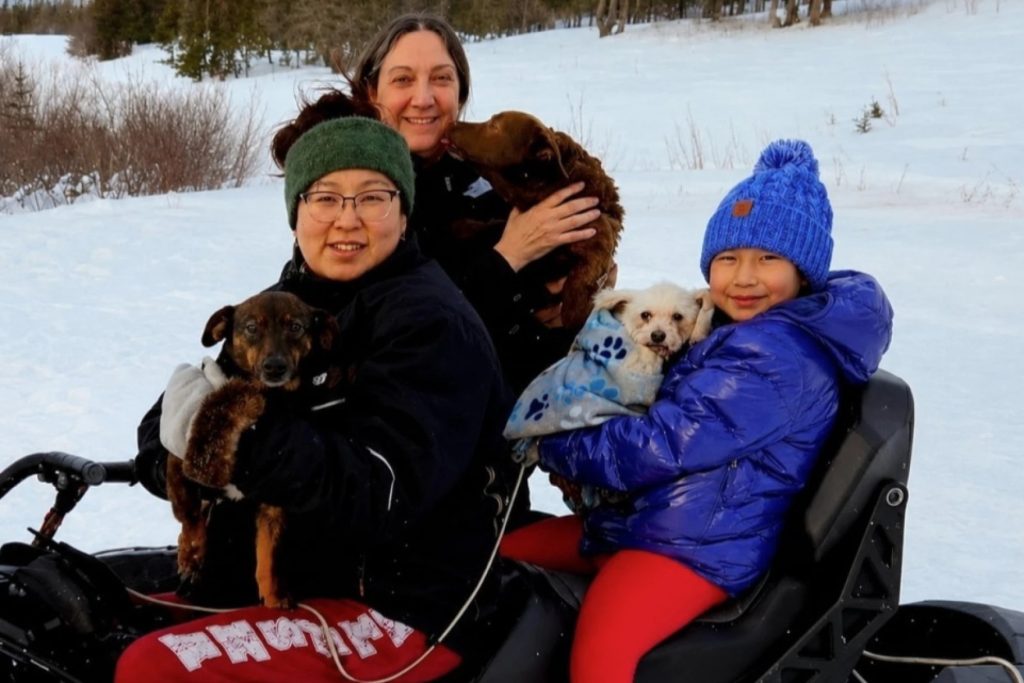
Photo: Angie Fitch, executive irector of Alaska Native Rural Veterinary, with two Koyuk residents and their pets during a recent visit. (Courtesy Angie Fitch)
A group of Alaska Native organizations is launching a new rural veterinary public health program this month to provide care for animals in dozens of tribes across the state.
As the Alaska Desk’s Alena Naiden from our flagship station KNBA reports, that includes rabies vaccinations, testing for infectious diseases, as well as spaying and neutering.
Mike Williams is a musher and the chief of the village of Akiak. He says he and other Alaska Native leaders for years have been advocating for more veterinary care in villages like his.
“In Akiak, there were two rabid foxes shot this past winter, and there are many loose dogs. I think the main need is vaccinations with rabies and parvo … that kills a lot of our animals.”
The Alaska Federation of Natives’ new program is in partnership with a nonprofit, Alaska Native Rural Veterinary. The two-year initiative will bring veterinary services to 80 villages.
Arleigh Reynolds is a former musher and the medical director for Alaska Native Rural Veterinary. He says rabies is endemic in northern and western Alaska, and up to 25 people are exposed to the virus each year.
The exposure usually happens when rabid wildlife, like foxes, bite village dogs.
“Dogs have been part of life in rural Alaska since people have been in rural Alaska. When something that has always been a huge benefit to a society becomes a potential threat, it’s really a problem, right? It disrupts the whole foundations of that society or culture.”
Reynolds says it is difficult to access veterinary care in villages off-the road system, and traveling to get care is costly.
Additionally, some parts of Alaska experience seven times the national average of reported cases of children bitten by dogs. He says he hopes the new initiative can help address both of these issues.
“Most importantly, it’ll save trauma on people and dogs, but it’ll also save communities and health-providing organizations an incredible amount of money.”
Taking care of pets in villages can also help protect subsistence resources, Reynolds says. One example is vaccinating against distemper that is contagious and fatal to wildlife, like seals that many Alaska Native communities hunt.
The authors of the new program say they hope it will act as a bridge on the path towards permanent and sustainable veterinary care for tribes.
 As communities across the country mark America’s 250th anniversary, a new augmented reality experience in Boston is highlighting Indigenous history that is often missing from the nation’s founding story.
White Snake Projects, in partnership with the North American Indian Center of Boston, has launched Indigenous Stories, a free, self-guided walking tour along Boston’s historic Freedom Trail.
Available through December 31, the smartphone experience guides visitors to six locations where they can view virtual performances by Native artists and learn about significant events in the city’s Indigenous past.
The tour explores the forced removal and imprisonment of Indigenous people on Deer Island during King Philip’s War, Native enslavement in colonial Boston, the life of African and Indigenous patriot Crispus Attucks, the 1755 scalp bounty proclamation targeting the Penobscot Nation, and the execution of Nipmuc leader Tantamous on Boston Common.
Organizers say the project is meant to ensure Indigenous voices are part of the conversation surrounding the nation’s semiquincentennial and to give visitors a more complete understanding of Native peoples’ role in Boston’s history.
Get National Native News delivered to your inbox daily. Sign up for our daily newsletter today.
Download our NV1 Android or iOs App for breaking news alerts.
Check out today’s Native America Calling episode