
Podcast: Play in new window | Download | Embed
Photo: Carlisle Barracks Post Cemetery in Carlisle, Pa. (Courtesy Office of Army Cemeteries)
The remains of 12 Native children who died while attending the Carlisle Indian Industrial School in Pennsylvania are beginning their journeys home.
The Office of Army Cemeteries is beginning its latest round of disinterments at the Carlisle Barracks Post Cemetery.
The children died more than a century ago while attending the federal boarding school, which operated from 1879 to 1918.
Carlisle became a model for the federal Indian boarding school system, where Native children were separated from their families and communities and forced to abandon their languages and cultures.
Families and Tribal leaders are gathering at Carlisle as the remains are prepared to return to their homelands.
According to ICT, this marks the ninth round of disinterments at the cemetery.
The 12 students include four Alaska Native children and students from several Tribal Nations across the country.
The repatriation process is scheduled to continue through October 12th, as descendants and communities bring the children home more than a century after their deaths.
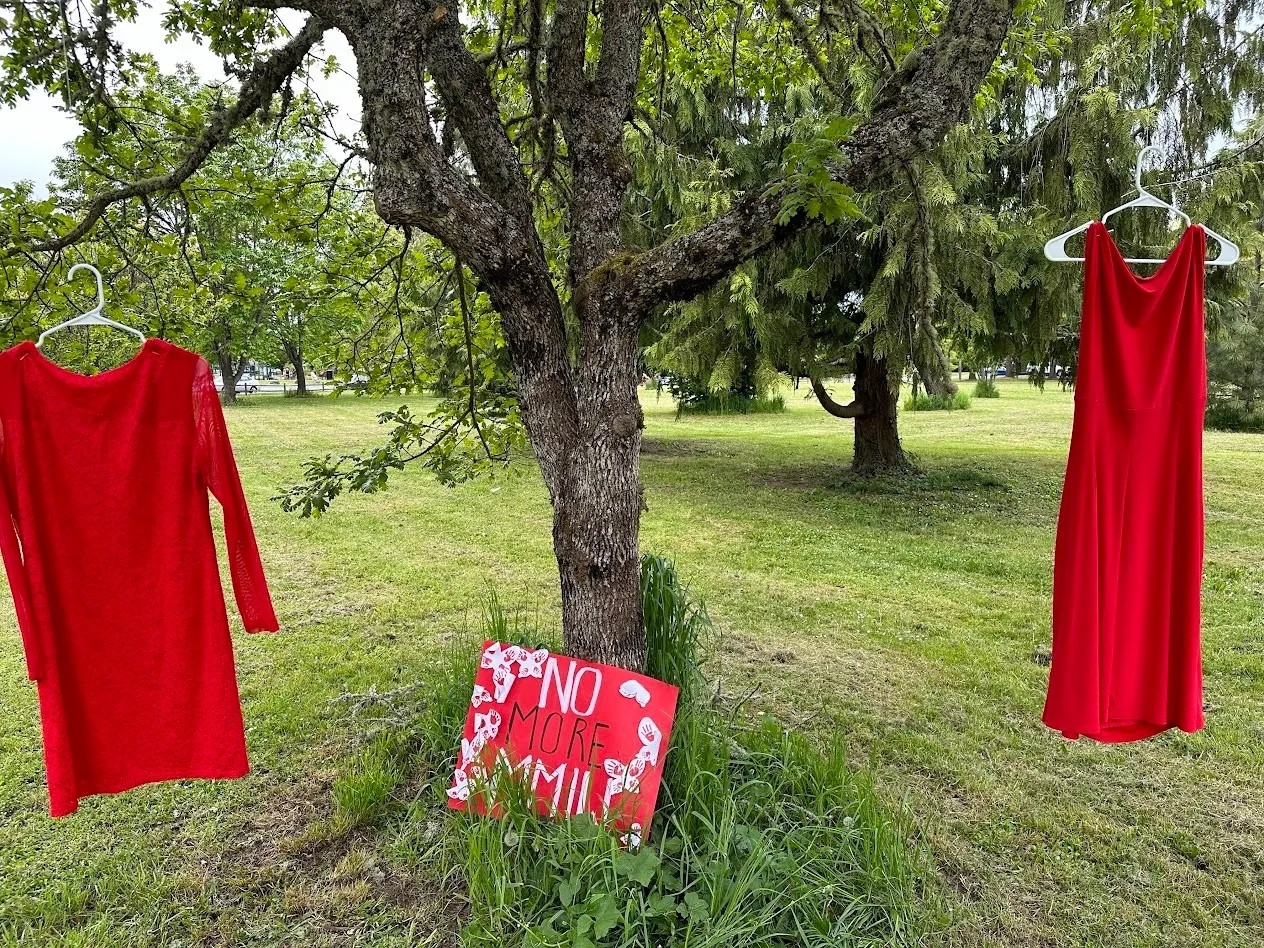
Red dresses and a sign reading “No More MMIW” adorn a tree in Heron Park in Springfield, Ore. during a special poetry reading on May 1, 2024. (Photo: Brian Bull)
Violence prevention, victim advocacy and MMIP services across Indian Country are dealing with disruptions and cuts at the federal level, as Brian Bull of Underscore Native News and KLCC reports.
A recent report from the Urban Indian Health Institute says more than 200 programs and organizations have lost funds or cut back services since President Donald Trump began his second term.
Whether through the so-called “Big Beautiful Bill” or initiatives against programs the White House deems “DEI” — diversity, equity and inclusion — or “woke”, many Native services are seeing support eroding.
Nearly two-thirds of respondents said they were “substantially impacted” by funding cuts since January 2025, with 60% of unmet need requests for safe housing support.
UIHI director Abigail Echo-Hawk said this will exacerbate issues for victims of domestic violence, sexual assault, and the Missing and Murdered Indigenous People crisis.
“They’re staying in their cars, they’re becoming homeless, they’re in shelters with their children, then having to move from one shelter to another. And in the worst case scenarios – that I know is happening – they’re going back to the people that are abusing them because they don’t want their children to become homeless, or they’re in such desperate circumstances, they have no other choice.”
State Representative Tawna Sanchez (Shoshone-Bannock and Ute descent), D-Oregon, has worked on MMIP and other Native issues. She is worried about how the Trump administration’s continued implementation of HR 1 will affect marginalized communities and vulnerable populations.
“The larger issue, right now, obviously, is: how do we value human life? Any life. And we have only begun to feel the effects of HR 1. The real effects are coming. And they’re going to be hard.”
Some Native advocates including Echo-Hawk say educating lawmakers can help. She said some anti-DEI initiatives have been reversed as tribes are political entities, not DEI.
Another advocate, Desiree Coyote, is the family violence services program manager for the Confederated Tribes of the Umatilla Indian Reservation. She says there is an obligation from the federal government to honor all treaties signed with tribes.
“This is part of what they agreed to do with us as tribal nations to help us ensure and protect our community in regards to public safety. I look forward to when the tribal nations – in regards to their sovereignty, as a way of ensuring intimate partner violence, sexual assault, dating violence, missing and murdered – are addressed quickly and in a meaningful way that benefits the people we serve.”
The report, titled “Sacred Responsibility: Protecting Our People“, includes recommendations for tribal and federal agencies.
Get National Native News delivered to your inbox daily. Sign up for our daily newsletter today.
Download our NV1 Android or iOs App for breaking news alerts.
Check out today’s Native America Calling episode


Leave a Reply