Podcast: Play in new window | Download | Embed
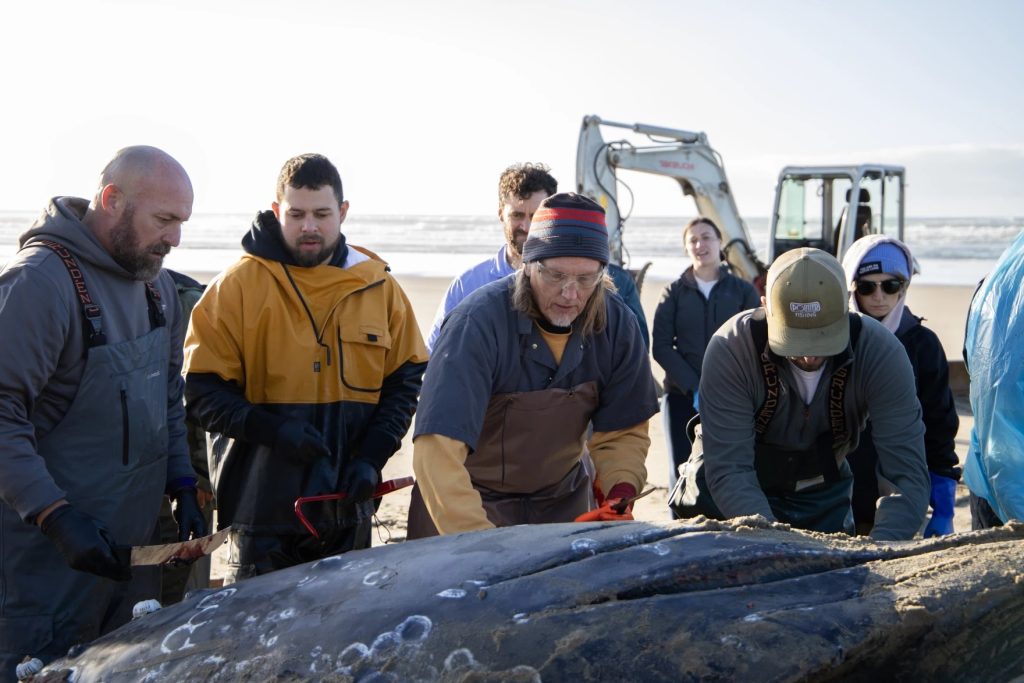
Photo: Siletz tribal members Todd Logan, Joshua Rilatos, and Dylan Gorman work next to anatomic pathologist Kurt Williams of the Oregon State University necropsy team on November 18, 2025, The tribe removed the whale’s blubber, bones, and baleen for cultural use, while the OSU crew took away tissue samples for diagnostic testing. (Jens Odegaard / Oregon State University)
A group of Siletz Indians in Oregon are holding a presentation this Saturday to honor a humpback whale that washed ashore in Lincoln County last fall and died.
As KLCC’s Brian Bull reports, it is to help non-Natives understand the historical and cultural significance of these mammals.
The Confederated Tribes of Siletz Indians (CTSI) sent a team in mid-November to do a traditional salvage of the whale, a common practice for coastal Native people for centuries.
Lisa Norton, CTSI’s chief administrative officer, and several others will discuss whales through storytelling, in a welcoming and open space near the Amanda Trail in Yachats.
Norton hopes the audience leaves with one main takeaway.
“Gaining and understanding of what it meant to us as a people, as individuals. And for those who were already connected with the whale, to understand that connection a little bit deeper or maybe understand that that connection isn’t over. And that it will live on in the stories that we do tell.”
Norton says CTSI’s cultural and natural resources department will eventually decide what will be done with the whale’s bones and other materials.
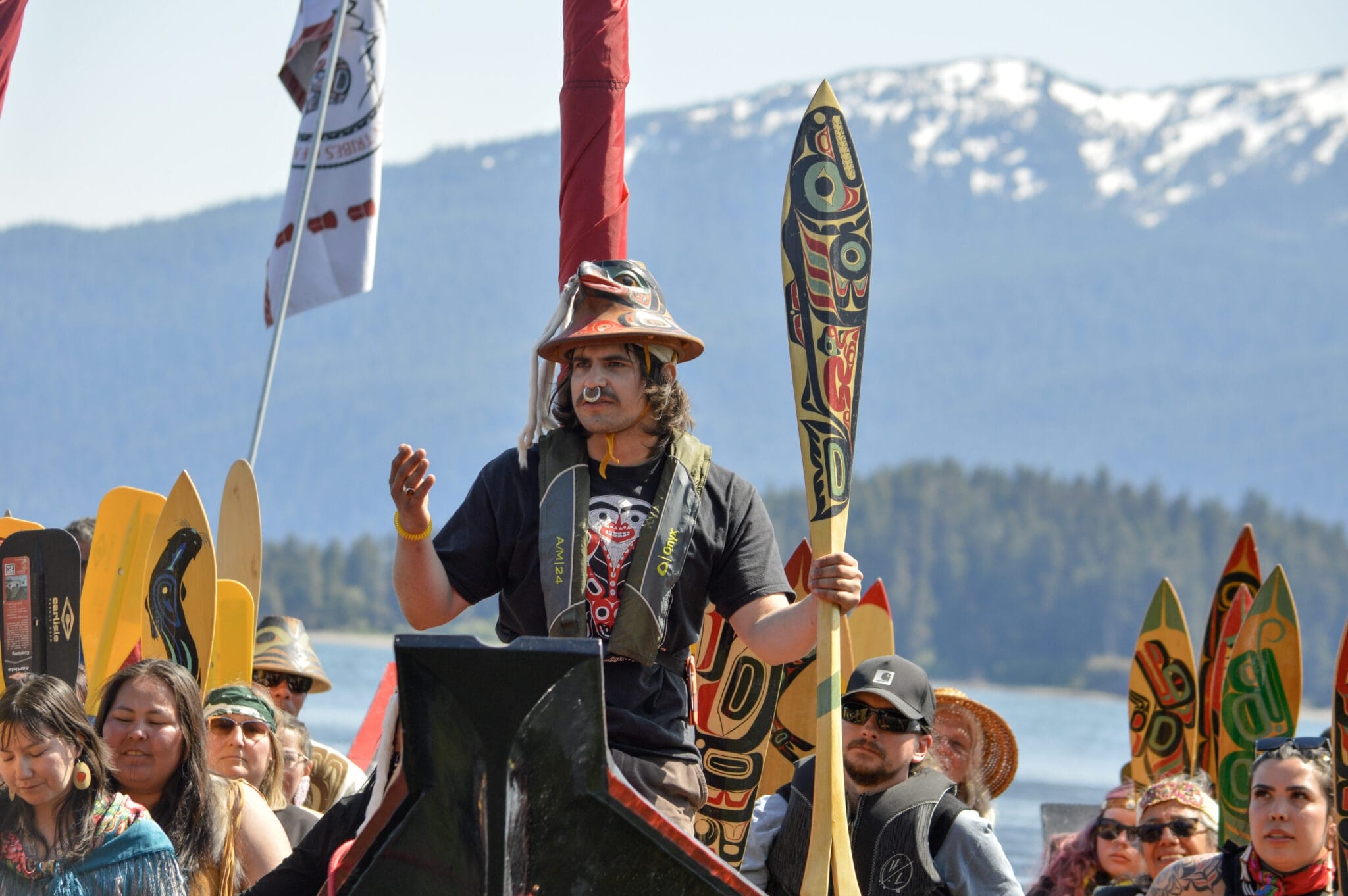
Ḵaayák’w Brandon Gomez introduces the Wind Dancer yaakw and asks permission to come ashore at Auke Recreation Area on June 2, 2026. (Photo: Yvonne Krumrey / KTOO)
Thirteen canoes bringing Alaska Native paddlers from across Southeast Alaska and Canada arrived in Juneau, Alaska Tuesday afternoon.
The canoes landed in two separate groups — one in downtown Juneau and the other at a traditional Aak’w (AHK) village site, north of town, as KTOO’s Yvonne Krumrey reports.
Áak’w Kwáan Elder Seikoonie Fran Houston waits on the shore at Auke Recreation Area as yaakw (canoes) enter the bay.
“It’s going to be good to see family and family and family and friends, and it’s a beautiful day, so the ancestors are happy also.”
Every other June, more than 100 paddlers arrive in Juneau this way to kick off Celebration, a gathering of Alaska Native people celebrating cultural revitalization.
Sealaska Heritage Institute started the event more than four decades ago.
They come to Celebration the old-fashioned way — paddling yaakw that were carved for this occasion.
Some travel from as far north as the Yukon.
“My name is Ughąts’etsӓna Ma. I’m Crow Clan. We’re from Dakwäkäda, Haines Junction, Yukon… We’re looking to celebrate now.”
Ughąts’etsӓna Ma Cheyenne Sparvier-Kinney introduces her boat to the shore. Later, she reflects on the multi-day journey down Lynn Canal.
“The journey was great. It was really a healing journey for a lot of us, not just our boat, but from the experiences that we’ve shared together. Yeah, it’s a healing journey for all of us.”
Others, like ShaaL’aanee Brandon Ware, are from as far south as Petersburg. This was the community’s first time sending a canoe to Celebration.
“Gunalcheesh for having us. We are so grateful to be here. Forgive me if I miss protocol, this is our first journey in over 100 years.”
In downtown Juneau, three yaakw make their way to shore as hundreds stand watching. As the yaakw neared, Shangukeidí Casey Moats stands up to greet the crowd.
“I had heard that I would never know my language, I’d never belong to a clan, I’d never have a name, I wouldn’t know my songs, and to do this means everything in the whole world.”
X’ash Kugé ka Yaanasax Barbara Cadiente-Nelson is a council member and secretary at Douglas Indian Association. She was one of the original planners for the first-ever Celebration in 1982.
As she watches the yaakw arrive downtown, she says that for Alaska Native culture to continue to flourish, the next generation has to be grounded in place.
“When you take a look around and you see our people of all ages and our youth, we are, yeah, and the young people that are singing and dancing, that they’re connected to place, they’re understanding and growing in their responsibility as Lingít, Haida, Tsimshians.”
Celebration officially starts Wednesday, with a Grand Entrance parade into Centennial Hall downtown. Over the coming days, there will be numerous events and ceremonies dedicated to honor and uplift Alaska Native culture.
With reporting help from Clarise Larson
Get National Native News delivered to your inbox daily. Sign up for our daily newsletter today.
Download our NV1 Android or iOs App for breaking news alerts.
Check out today’s Native America Calling episode